Anxiety Comes From Believing You Can Still Change Something
This article is 5,000+ words and takes about 8 minutes to read.
Why This Topic?
You might think I’ve been feeling anxious lately—but quite the opposite. Anxiety has been a recurring topic in my recent conversations with friends, and I consider myself to be doing fairly well in this regard, with my anxiety level probably sitting below the median (though this estimate isn’t exactly scientific). I’ve vaguely sensed that I have a loose set of strategies, but I’ve never systematically examined this phenomenon.
After finishing my work tonight, I suddenly felt like discussing this topic with AI. It’s also been about two weeks since I last connected with readers, so I decided to turn tonight’s thought process and insights into an article—both to deepen and organize my thinking, and hopefully to offer readers some inspiration. Feel free to wander along with me. If you’re not interested in my iterative thinking process, you can jump straight to the “A Formula” section and beyond for the summary.
PS: AI has genuinely proven to be a remarkably insightful deep-conversation partner on this topic. I’d heard about it before but hadn’t practiced it much. This session used Claude, spanning 62 rounds of dialogue, and the experience was quite impressive. By prompting it to use a Socratic questioning style, it helped me uncover potential biases in my existing understanding round by round, ultimately elevating my cognitive grasp of this topic by a clear notch. If you haven’t tried it yet, I’d encourage you to pick a topic and have a deep conversation with AI—you might be surprised by what you discover.
From Experience: A Vague Understanding of Anxiety
Previously, my understanding of anxiety came mainly from scattered information and personal experience, roughly as follows:
- Anxiety is essentially a worry about future uncertainty. If something is already settled, there’s no anxiety;
- Sometimes, people feel anxious about something because their understanding and planning around it are incomplete—i.e., it’s “not specific enough.” If you actually start doing it, the anxiety tends to diminish;
- For things you can barely influence (like hoping to roll a “6” with dice), even though the outcome is completely uncertain, you don’t feel anxious because you know no amount of effort can change the result (at least I can’t~);
- What makes people most anxious often has this characteristic: although the outcome is uncertain, you feel that your effort can influence its direction. In other words, the core of anxiety lies in “I believe I have the ability to influence an uncertain outcome.”
Based on these observations, I began a Socratic dialogue with Claude.
The First Crack: Is Uncertainty Really the Root Cause?
Claude offered an example challenging this proposition:
Imagine someone enters the civil service system, with a very stable job, and the next 20 years are clearly visible ahead. But they feel that this certainty comes at the cost of a decline in their personal ceiling. In this case, the certainty of “seeing exactly how life will unfold” might actually make them anxious, feeling that this is all their life will ever be.
PS: This is merely relaying the AI’s example and does not represent the author’s views.
This indeed contradicts the idea that “anxiety stems from worry about future uncertainty,” and it conflicts with popular intuition. Why does certainty also cause anxiety in this scenario?
Thinking further, I realized that logically, there’s no direct derivation linking anxiety to uncertainty. Conceptually, anxiety is a psychological state, while uncertainty is merely one possible trigger for awakening that state.
Looking back at my own experiences, the situations that made me anxious mostly related to point four: I felt I could change certain circumstances or expectations.
For example, if you’re preparing for an exam, on one hand you want a good score, but on the other hand, laziness or other factors might make you less willing to invest significant effort. In that case, you might experience psychological pressure like:
What if I don’t prepare enough and fail?
This pressure can be summarized as: for a given goal, insufficient effort might lead to unsatisfactory results, and I “could have“ tried harder, which might have improved the outcome.
The premise here is that the final result, at least in people’s perception, can be influenced by greater investment, and in a positive direction.
“Inevitable” or “Avoidable”?
Claude then raised a question challenging my current framework. In academia, Barlow’s anxiety theory posits that the sense of uncontrollability and unpredictability regarding future threats is the core psychological mechanism of anxiety. But my earlier understanding suggested that anxiety arises precisely when one can exert influence—are these two views in conflict?
David H. Barlow: Professor Emeritus of Psychology at Boston University, a leading authority on clinical anxiety. He proposed the “triple vulnerability model” of anxiety, arguing that “uncontrollable/unpredictable” schemas formed through early experiences are the psychological core of anxiety disorders. His representative work is “Unraveling the Mysteries of Anxiety and Its Disorders,” published in American Psychologist in 2000.
In my view, these aren’t in conflict, because “inevitable” means the problem requires a deliberate decision—namely, how much effort I’ll invest. Anxiety only arises when my effort allocation can influence the final outcome.
Consider an extreme example: there’s a Chinese idiom, “杞人忧天” (the man of Qi worried the sky would fall). Everyone knows what it means. For things entirely beyond our sphere of influence, we don’t truly feel anxious. Since the outcome isn’t affected by effort at all, the meaning of increasing or decreasing investment disappears, and anxiety has no basis to emerge.
Is “Lying Flat” the Optimal Solution?
Claude then posed another question: if someone voluntarily gives up their agency over future actions and simply “lies flat,” is that a valid approach?
Based on our earlier conclusion, if someone logically relinquishes their future choices, they would indeed seem to stop feeling anxious—because without choice, outcomes are no longer tied to one’s actions, and anxiety loses its purpose.
But eliminating anxiety entirely isn’t the ultimate goal—at least not for me.
In other words, minimizing anxiety is a means, not the end. The real goal is advancing the things I consider valuable—and those things often require me to bear a certain degree of psychological tension. Chasing zero anxiety might systematically lead me to avoid the very things worth doing.
For me, there’s no single supreme purpose. The things I care about hold value across different dimensions, and no single metric can absolutely determine which matters most.
I Care
If someone feels anxious about something, there must be a premise: they care about it.
This is easy to understand. We probably don’t care about an ant we accidentally step on. Even if it’s a catastrophe for the ant, we might not even notice its existence. In that case, there’s no anxiety.
And intuitively, the more you care about something, the more your anxiety about it is amplified.
Anxiety can’t be quantified, but perhaps a formula can help us understand the influencing factors. On the left side is the degree of anxiety, and on the right, there’s already a ready-made multiplicative factor: how much we care. What else? Besides the worry about “insufficient effort leading to worse outcomes,” is there anything else?
The U-Shaped Impact of Investment on Psychological Pressure
Guided by Claude, I thought of another kind of anxiety: if I double down on effort and the result is still bad, can I accept that?
In my past experiences, most of the time I couldn’t accept the cost of sunk costs. The anxiety it produced was even deeper than that caused by “insufficient effort.”
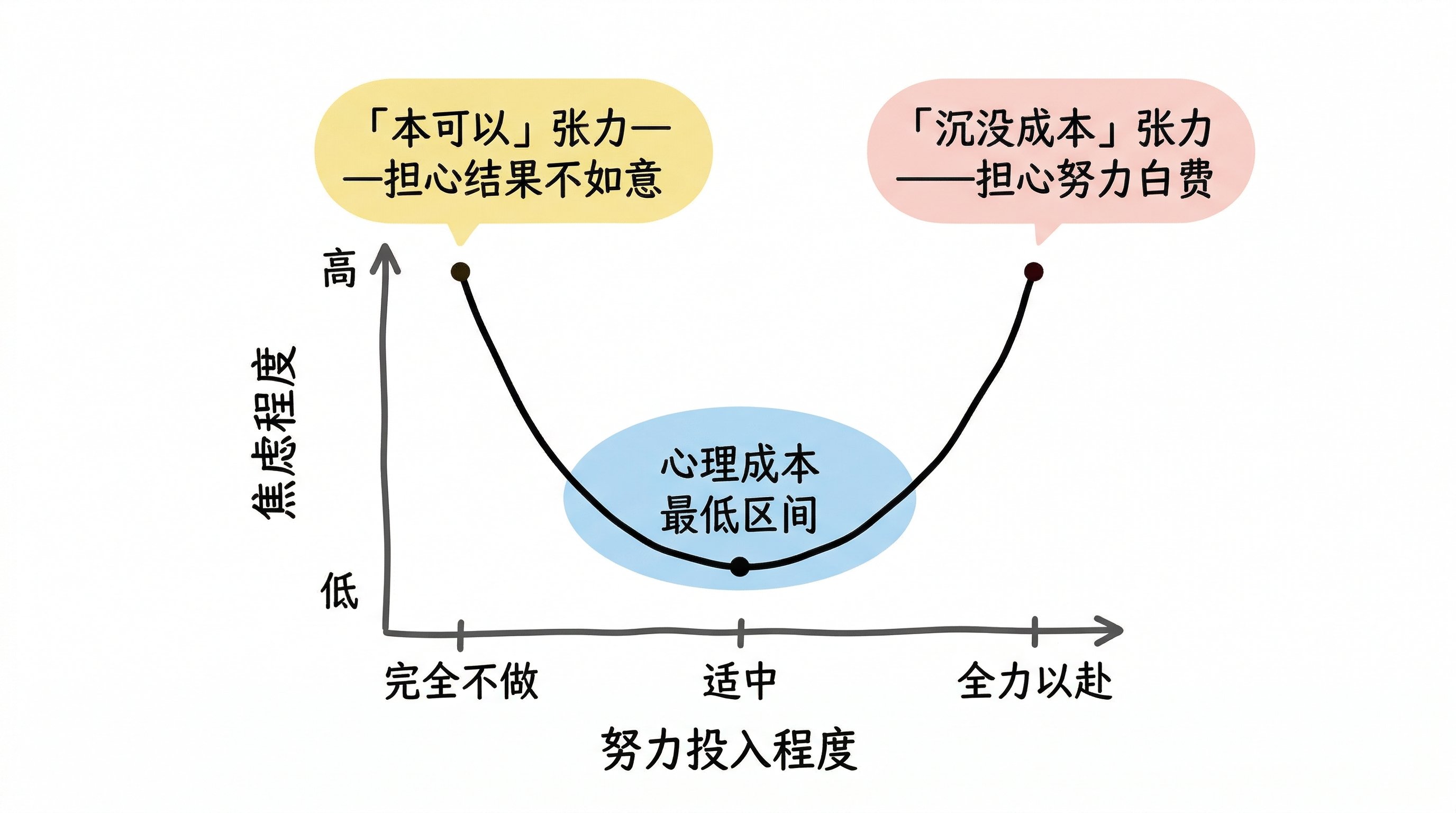
So we can draw a curve. With effort on the horizontal axis and psychological pressure (anxiety level) on the vertical axis, we get a U-shaped curve: both ends (zero investment or going all-in) produce high anxiety, while moderate investment yields the lowest psychological cost. The logic behind this needs to be examined from both endpoints. Things we care about often can’t be fully controlled by individual effort.
If I don’t try at all, the expected outcome will be low. In that case, I have to face the psychological pressure of a potentially unsatisfactory result.
At the other extreme: if I go all-in and still fail, I’ll bear the pressure of emotional sunk costs and the loss of rational opportunity costs. Because I “could have” allocated that attention to other potentially meaningful directions.
Therefore, allocating moderate attention avoids both worrying about results from not trying and bearing the anxiety of sunk costs from going all-in—purely from an anxiety-relief perspective, this is the optimal solution.
People don’t focus on just one thing. In reality, we may need to weigh multiple such matters and rationally allocate our attention across them.
From a rational standpoint, if we could truly quantify how much we care about each thing, then from an anxiety-reduction perspective, a better decision strategy would be: prioritize allocating moderate attention to the things we care about most, in descending order—neither completely ignoring them nor going all-in.
PS: Note that this is from an anxiety-relief perspective. Minimizing anxiety may not be our only pursuit.
A Formula
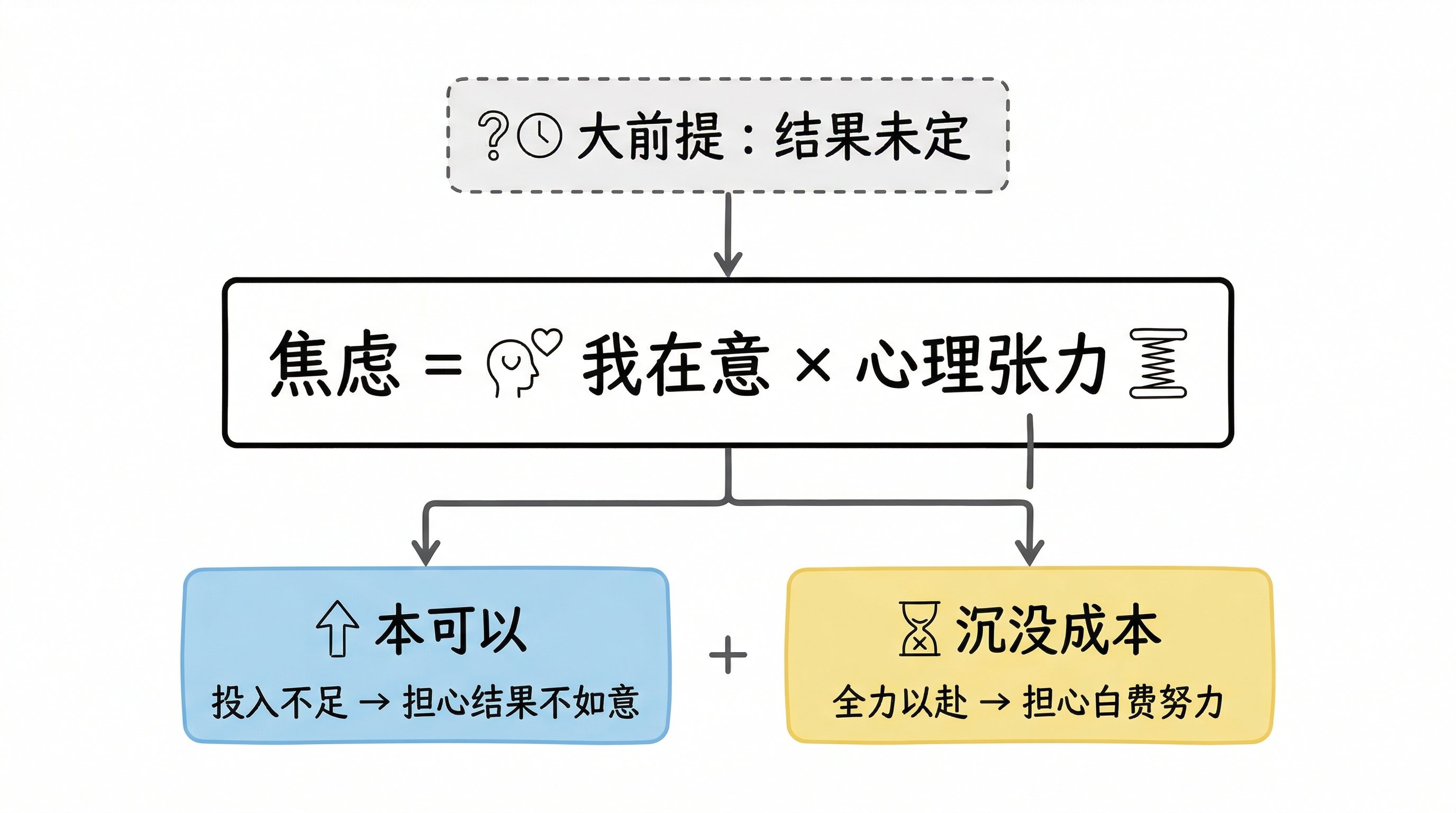
So, here’s the formula we’ve arrived at: under the premise of an undetermined outcome, and with remaining attention resources to allocate:
Anxiety = I care × (“Could have” + “Sunk cost”)
Where:
- I care: My degree of concern for the matter
- “Could have”: The consequence of bearing an unsatisfactory outcome when under-investing attention
- “Sunk cost”: The possibility that effort invested goes to waste when going all-in
You May Have Already Applied This Formula Subconsciously
This formula can help us proactively relieve anxiety. But in fact, in our past decisions, we’ve likely already applied it subconsciously, naturally choosing the approach with the lowest psychological cost.
Let’s return to the earlier question: is the lowest psychological cost what we actually want?
I asked myself. For me, it’s not.
In many past decisions, I may have overestimated the impact of Tension B (psychological sunk costs), to the point of outright rejecting certain endeavors or abandoning them halfway.
And that’s simply because: I’m afraid that even with effort, I might fail—so why not focus my attention on other things instead?
This has significantly limited my exploration of richer dimensions and domains, keeping me stuck in my “comfort zone.”
This serves as a wake-up call: the psychological cost of anxiety is only a short-term effect. The choice with the lightest psychological burden in the short term isn’t necessarily what we truly want in the long term. The decision that’s psychologically optimal may systematically underperform in terms of output, while also systematically reducing the probability of doing things well.
Can We Have Both Short-Term Anxiety Relief and Long-Term Progress?
Following the logic of anxiety minimization, we seem inevitably led to systematically reducing attention allocation. But if we increase attention to things we care about, anxiety seems to inevitably rise.
Can’t we have both? Can we allocate higher attention to things we care about more, while simultaneously relieving the anxiety (mainly “sunk cost”) that comes with it?
Claude asked me: why did you originally think you didn’t feel all that anxious?
I told him about some recent experiences. His interpretation was this:
The reason my anxiety is relatively low isn’t because I avoid situations that fit the formula—in fact, those situations are real. Rather, in past decisions, I had a relatively natural tendency: to choose paths that could advance multiple “things I care about” simultaneously, rather than betting all my attention on a single external outcome.
This approach objectively reduced the psychological tension of “sunk cost”—because even if the highest-level goal wasn’t achieved, what was accumulated along the way still advanced other directions I care about. In other words, “failure” was diluted: it no longer meant “everything was wasted,” but rather “the top goal hasn’t been reached yet.”
But I also realized that this tendency had been implicit and unconscious in the past. Tonight, it was named explicitly for the first time.
The crux of the issue lies in: who holds the authority over what you “care about.”
If what you care about largely requires external recognition—like entrance exams or career promotions—then these things tend to be atomized and siloed. You must allocate your limited attention to them and bear the dual psychological pressure of “could have” (from under-investment) and “sunk cost.”
But if a significant portion of what you care about only requires your own recognition, then the room for maneuver expands considerably. In fact, many things you care about aren’t a single concrete matter. Things like health or hobbies are self-created cares that can be tied to specific activities—even achieving multiple purposes within a single concrete endeavor. For example, if you enjoy playing badminton, you can simultaneously satisfy your hobby interest and improve your health.
In reality, it’s often a mix: people have “cares” derived from external standards (which they can’t fully control) and “cares” that originate internally. When considering how to allocate attention, we can try to uncover the internal “cares” within external ones, combine the two, and prioritize allocating more attention to things that integrate multiple “cares.”
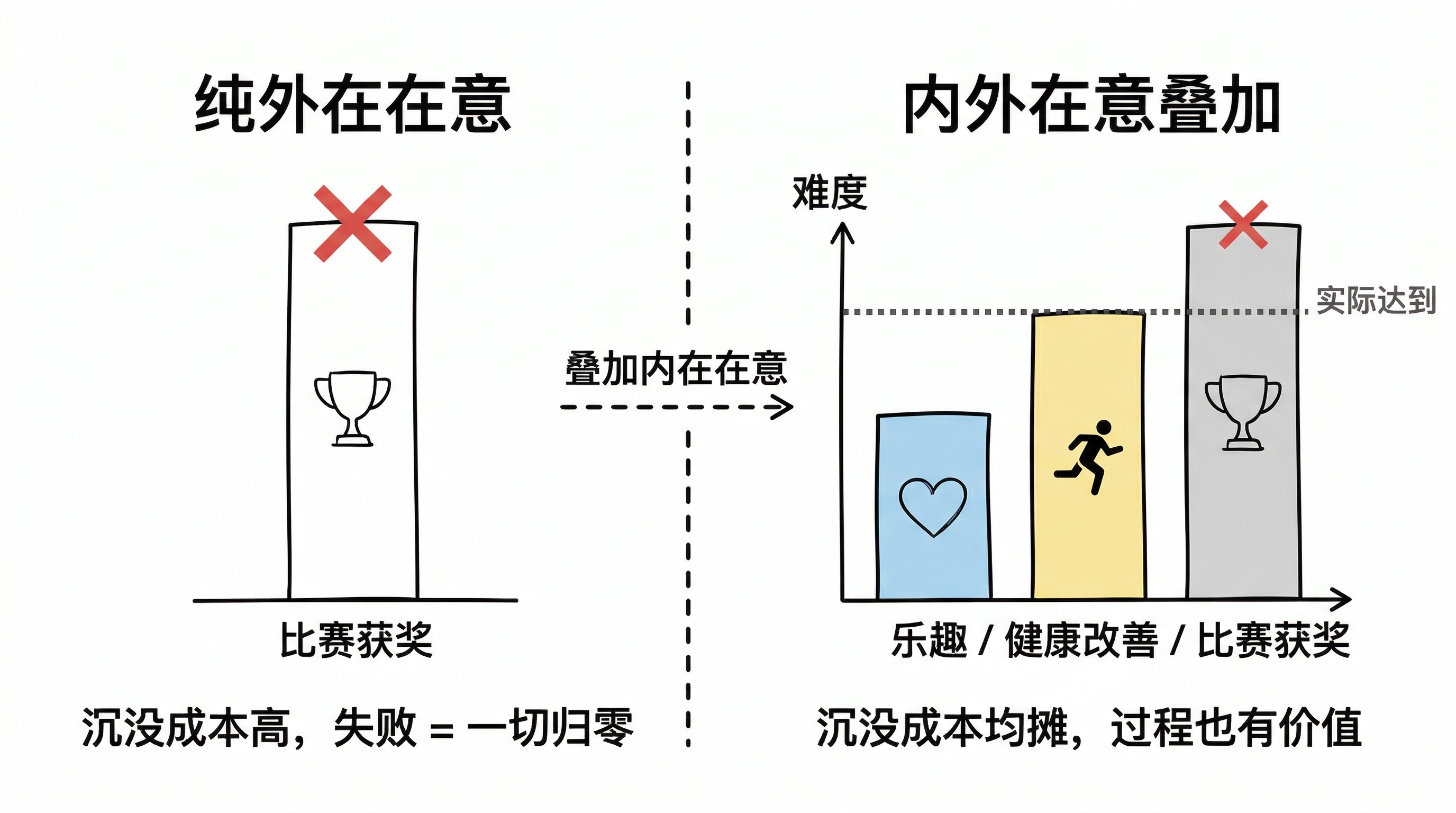
This way, we can distribute the “sunk cost”/“opportunity cost” across multiple dimensions. If we simplify the model and treat each matter as atomized—where a thing is either a success or a failure—then this approach’s advantage is that it transforms a 0-1 distribution into a multi-layered payoff matrix, greatly compressing the probability space of “complete failure.” Even if the highest-level goal isn’t truly achieved in terms of outcome, the effort you put into the process still helps advance other things you care about.
Suppose you’re a badminton enthusiast who signs up for a tournament two months away. If your only concern is winning, the pressure of anxiety might push you toward a strategy with the lowest psychological cost and suboptimal attention allocation. But if you also integrate your internal cares—your love for the sport itself, your pursuit of health—then even if you don’t achieve the result you hoped for, the enjoyment from training and the improvement in health mean you “don’t lose”: those “sunk costs” are no longer silent.
Following this line of thinking, we have two optimization approaches. The first is simpler and can take effect immediately: explore which potential internal cares exist within the external cares you’re currently pursuing, thereby directly relieving psychological pressure or enabling higher attention allocation to advance that cluster of cares. The second is for future decisions involving external cares: prioritize options that can incorporate internal cares, getting as close to them as possible. This subtly helps us become the person we truly want to be.
So, can we have both short-term anxiety relief and long-term progress? While we can’t achieve theoretical optimums for both simultaneously, we can significantly optimize.
Answering the Unanswered Questions
Let’s revisit my four original starting points with Claude and see how our iterated cognitive framework deconstructs them.
First, “anxiety is worry about future uncertainty”—we’ve shown that the core isn’t uncertainty itself, but “undeterminedness“: for things you care about, the future can still be influenced to some degree by changing your effort or attention allocation. This is the foundation on which the entire formula rests, not an independent variable.
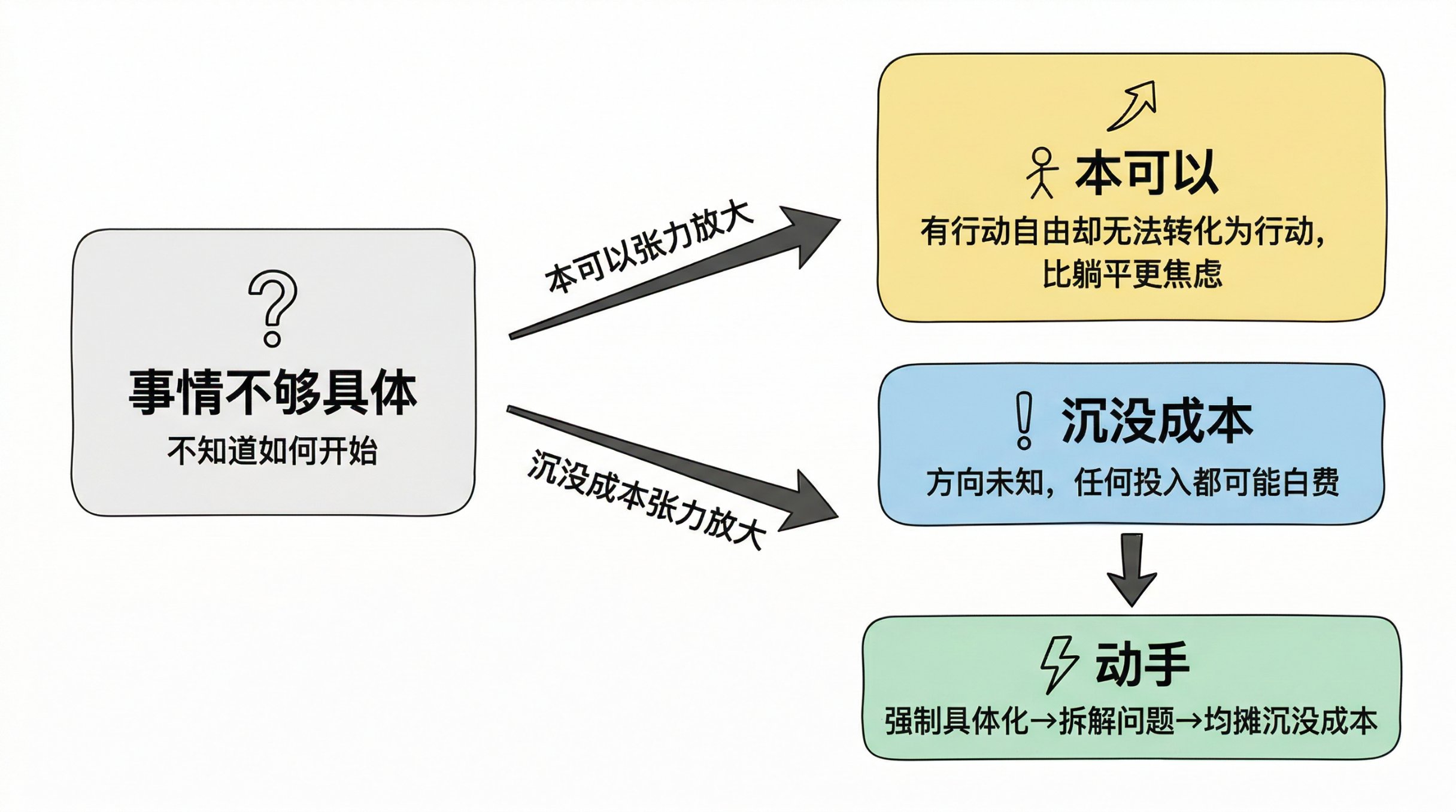
Second, “not being specific enough” is a trigger for anxiety—we haven’t addressed this yet, so let’s analyze it here. If something isn’t specific enough, both “could have” and “sunk cost” are amplified simultaneously.
On the “could have” side, you know your effort can influence the outcome, but you don’t know where to start. You have the freedom to allocate attention, but that freedom can’t be converted into action. This state is actually more anxiety-inducing than giving up freedom entirely (like “lying flat”).
On the “sunk cost” side, precisely because you don’t know how to begin, any investment might be misdirected, amplifying the fear of sunk costs.
Taking action is essentially forcing the process of specification to begin, bringing the framework back to an operable state. When you actually start doing, what happens is: the vague big problem gets decomposed into a series of concrete small problems, each with a relatively clear action path. This is equivalent to breaking a single massive uncertainty into multiple smaller, incrementally addressable uncertainties. This transforms a simple 0-1 distribution into a multi-layered payoff matrix, distributing the “sunk cost.”
Third, for things you can barely influence (like hoping to roll a “6” with dice), even though the outcome is completely uncertain, you don’t feel anxious.
This dimension seems to satisfy the precondition of an undetermined outcome and I care, but both tensions disappear simultaneously. “Could have“ is meaningless, and “sunk cost“ doesn’t exist—because you wouldn’t even consider increasing or decreasing attention allocation toward it.
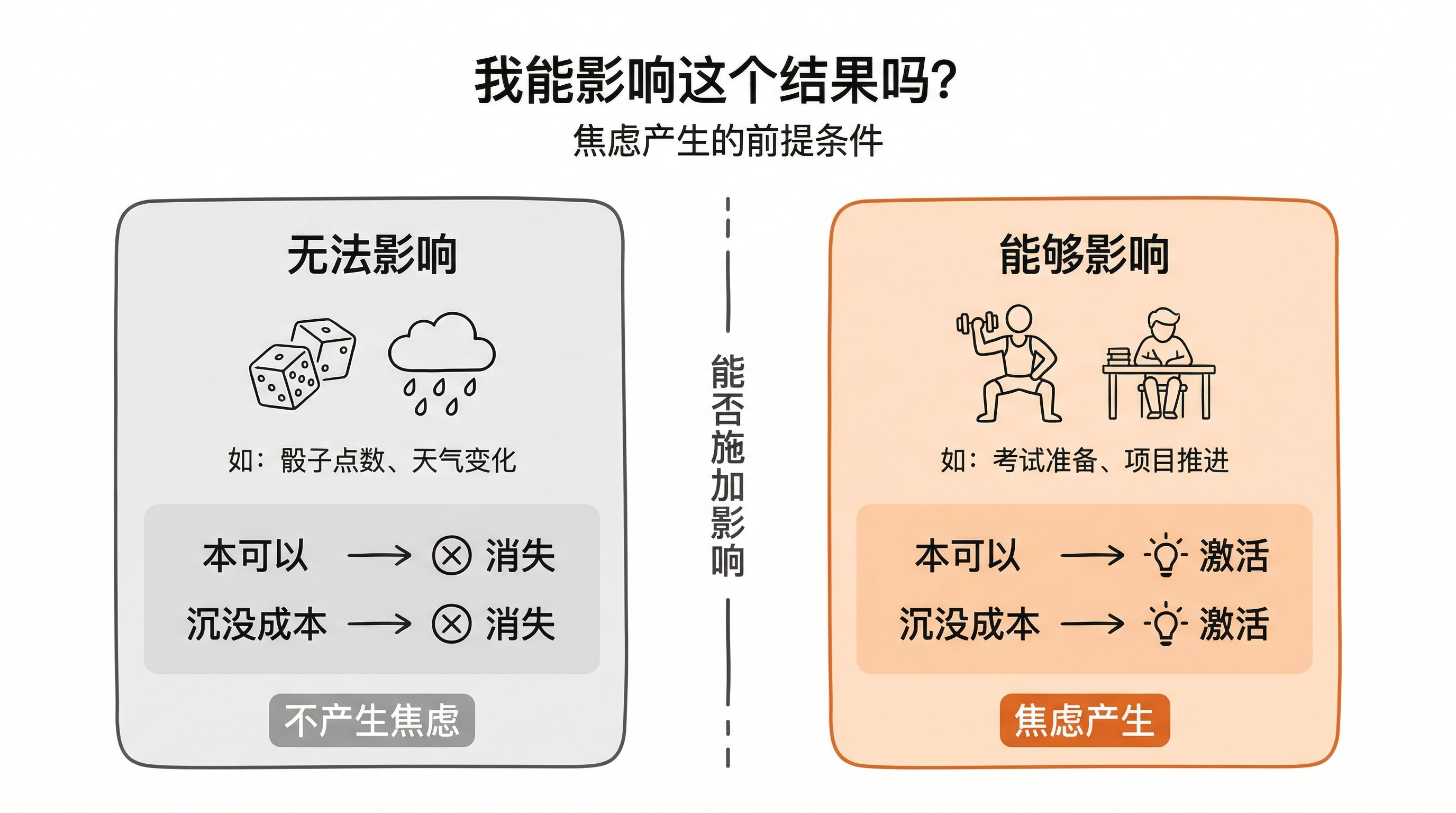
Fourth, the core of anxiety lies in “I believe I have the ability to influence an uncertain outcome.” Clearly, our formula perfectly explains this. It’s precisely because you believe you can influence the outcome that the tension of “could have” holds. If there’s no possibility of influencing the result, how could “I could have tried harder” even arise?
So What Should We Do?
My thinking tends to stay in my head without being put into practice. So now, whenever I have a deeper reflection, I force myself to create an actionable checklist and ask: “Given this, what should I do?”
By this point, the draft has exceeded 5,000 words, and it’s taken over two and a half hours. Below, I took a shortcut and had Claude help me organize it:
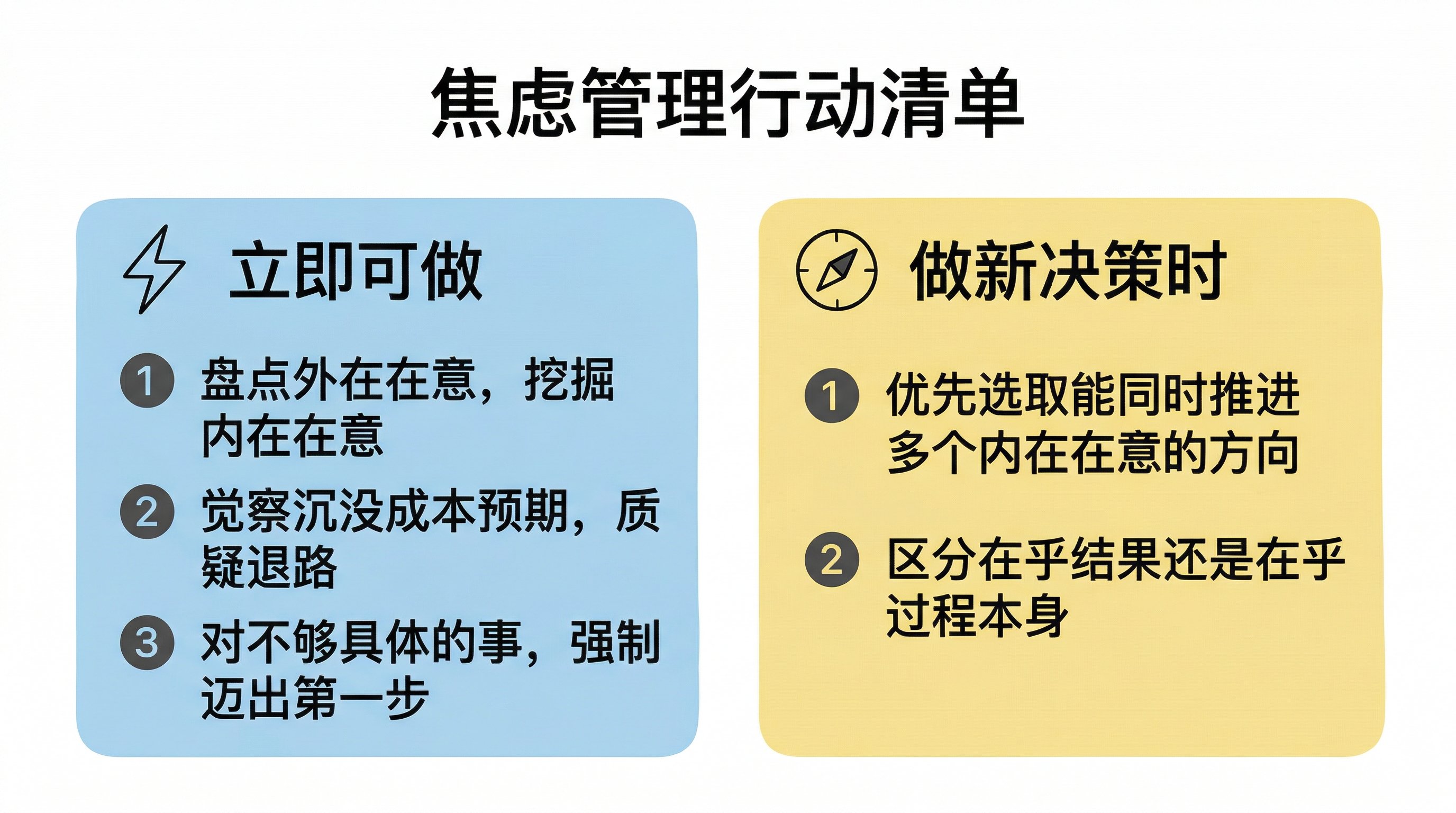
Do immediately:
- Take stock of your current “external cares” and ask yourself one by one: is there a part of this that I’m genuinely interested in internally? Write it down explicitly, so it no longer exists only implicitly.
- Notice whether you’re giving up early due to anticipated sunk costs. The next time you catch yourself saying, “Forget it, even if I try, it’ll be wasted,” pause and ask: is this a genuine rational judgment, or am I using Tension B as an escape route?
- For things that aren’t specific enough, force yourself to take the first step. Vagueness amplifies both tensions; action is the only antidote. You don’t need to have it all figured out before starting.
When making new decisions:
- Prioritize directions that can advance multiple internal cares simultaneously. The more of what you truly care about a single unit of attention can serve, the lower the psychological pressure of sunk costs and the less resistance to action.
- Distinguish between “caring about the outcome” and “caring about the process itself.” The former makes you more susceptible to Tensions A and B (author’s note: “could have” and “sunk cost”); the latter gives you a stable anchor for action even when the outcome is undetermined.
Not bad—hope it offers some inspiration to us all.