Reflections on “Unknown Podcast E45: Meng Yan in Conversation with Li Jigang — How Should We Position Ourselves”
Although this episode has been out for a while, it really resonated with me. I listened to it over two days, then took another day to organize my thoughts. This is also the first time I’ve seriously written up my reflections on a podcast. I’m a heavy podcast listener, but I rarely write dedicated posts like this — mostly because a lot of podcast content is scattered and only worth jotting down a few fragmented notes in Notion. This episode was different: it contained several ideas that genuinely made me want to pause and write a standalone piece.
Note: This article is not a complete summary of the podcast. If you need that, AI does a far better job than I do. If you’re interested in the content, I recommend listening to the original episode directly. This article only records the ideas that truly “struck” me during listening, with some personal reflections added on top. Although I’ll try to distinguish between the two, some paraphrasing may unintentionally blend in my own thoughts — please defer to the original podcast for accuracy.
Ideas that particularly resonated are marked with “💡.”
Personal reflections will be presented in this annotation format to distinguish them.
1. The “Viewfinder”
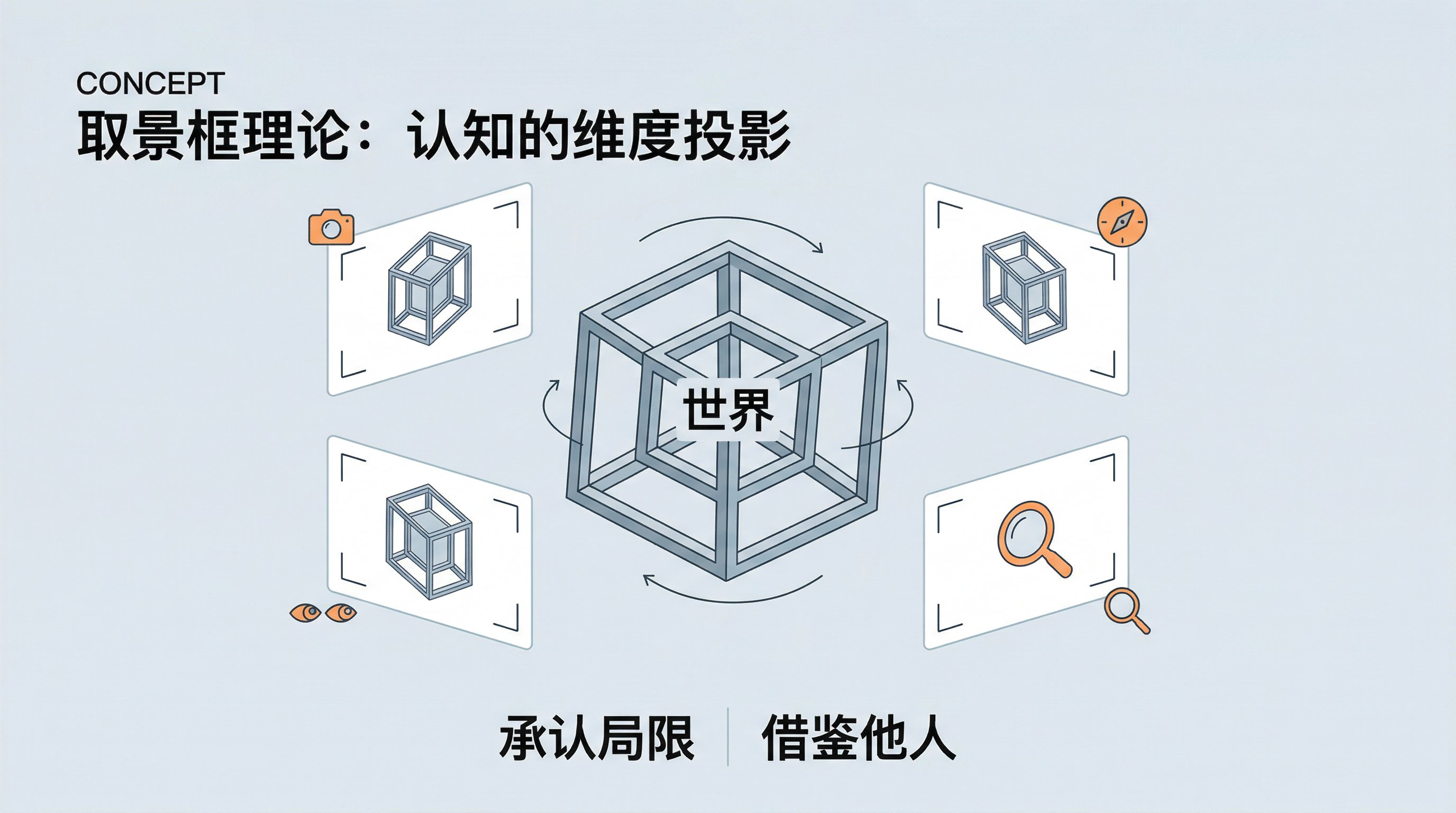
The guest suggested that everyone views the world through a different lens, which he calls a viewfinder. This viewfinder is essentially a projection of the multidimensional world onto certain dimensions. In other words, within a specific context, what the viewfinder displays aligns with one’s cognition. But the problem is that each person’s viewfinder detects different dimensions. Therefore, one should acknowledge the limitations of their own viewfinder and actively learn from others’ viewfinders to gain a more complete understanding of the world.
Note the distinction between “me” and “my viewfinder.” My viewfinder is a relatively static concept — it represents how I see the world at a given stage of growth. “Me,” on the other hand, is a dynamic concept that continuously iterates as I grow.
2. Wealth-Share Investing
What we pursue in investing isn’t the absolute amount of money we make. Essentially, we should adopt a more illuminating framework. That is, our goal should be to maximize our personal wealth as a share of total global wealth — or at minimum, prevent that share from declining. From this perspective, we simply need to allocate capital to assets that will become increasingly mainstream and larger in scale over time. This is a macro, long-term overarching goal.
If you hold all cash or keep everything in Yu’ebao, at least for now, cash depreciates. So this approach doesn’t achieve the goal above.
💡3. The Compression of Time and Space in Knowledge Acquisition
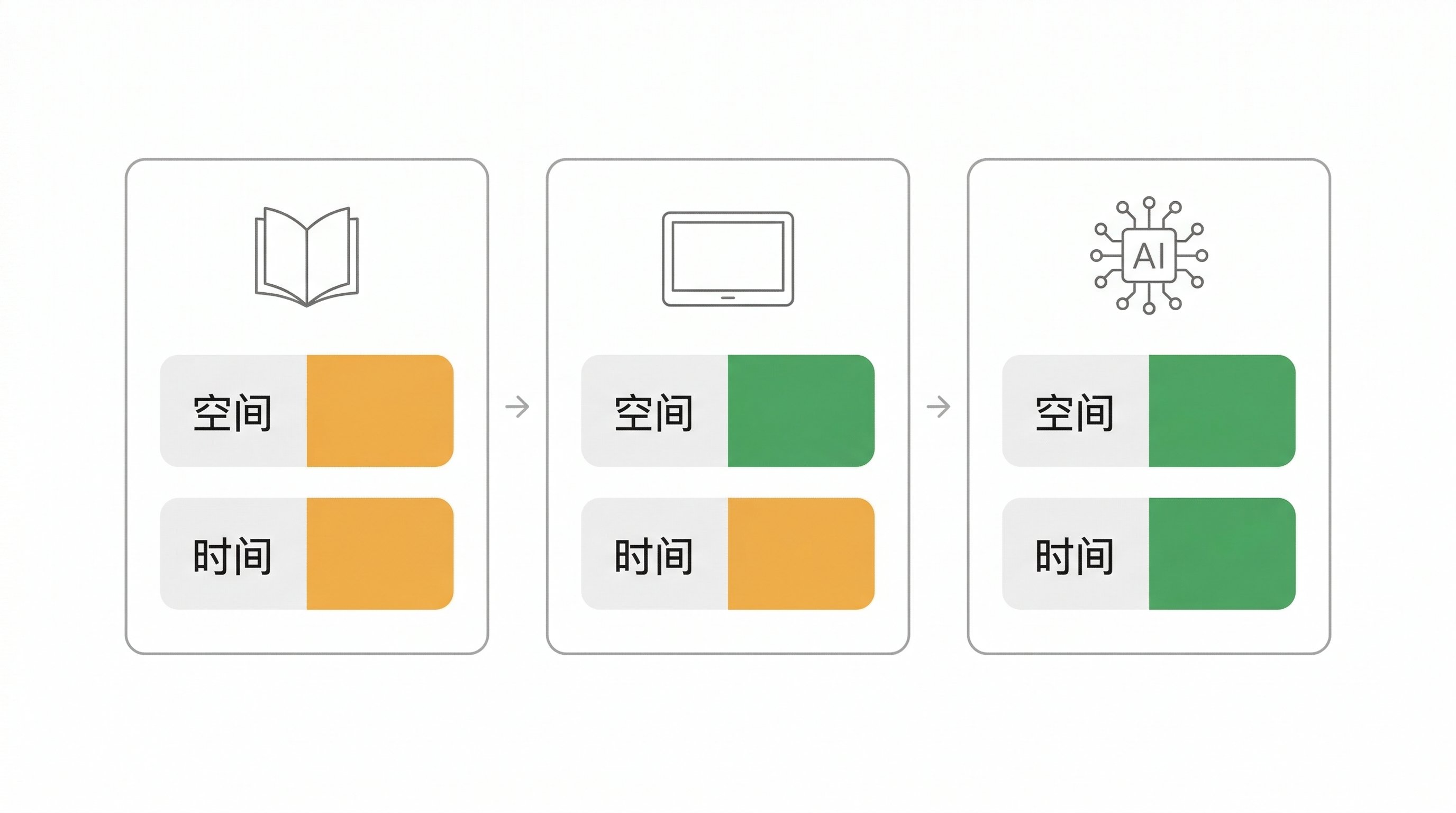
Looking at the history of human reading and learning, the earliest form was reading physical books. We can analyze this along two dimensions: space and time. Traditional reading requires occupying both space and time. Space means books have physical volume; time means you need to read, understand, and think before you can truly master the knowledge. In the internet age, many things became digitized — physical space disappeared, converted into digital space. But the time dimension remained.
For example, when you read an e-book, you still need to understand and digest the content yourself to grasp its essence. But now, with the emergence of AI, the final time dimension has also been compressed. Previously, you had to read an entire book and chew on it repeatedly to gain knowledge; now you can simply ask a large model, or have it summarize for you. This saves time. At this point, the barriers to knowledge have been greatly reduced along both the time and space dimensions.
Another example: there used to be physical distance between China and the US. But after the internet, the two sides could largely overcome spatial differences and engage in much closer, more frequent communication.
4. AI Is a Better Conversational Partner
Conversations with AI can go deeper than conversations with humans. AI has learned a large portion of human knowledge — LLMs integrate vast amounts of knowledge and wisdom that no single person can match. Therefore, we should actively exchange ideas with AI.
5. The Meaning of Careers in the AI Era
Many professions facing AI in the future will confront the same question that professional chess or Go players faced when encountering the insurmountable mountain of artificial intelligence: what is the meaning of competitive play?
This analogy is very interesting.
💡6. How to Read in the AI Era
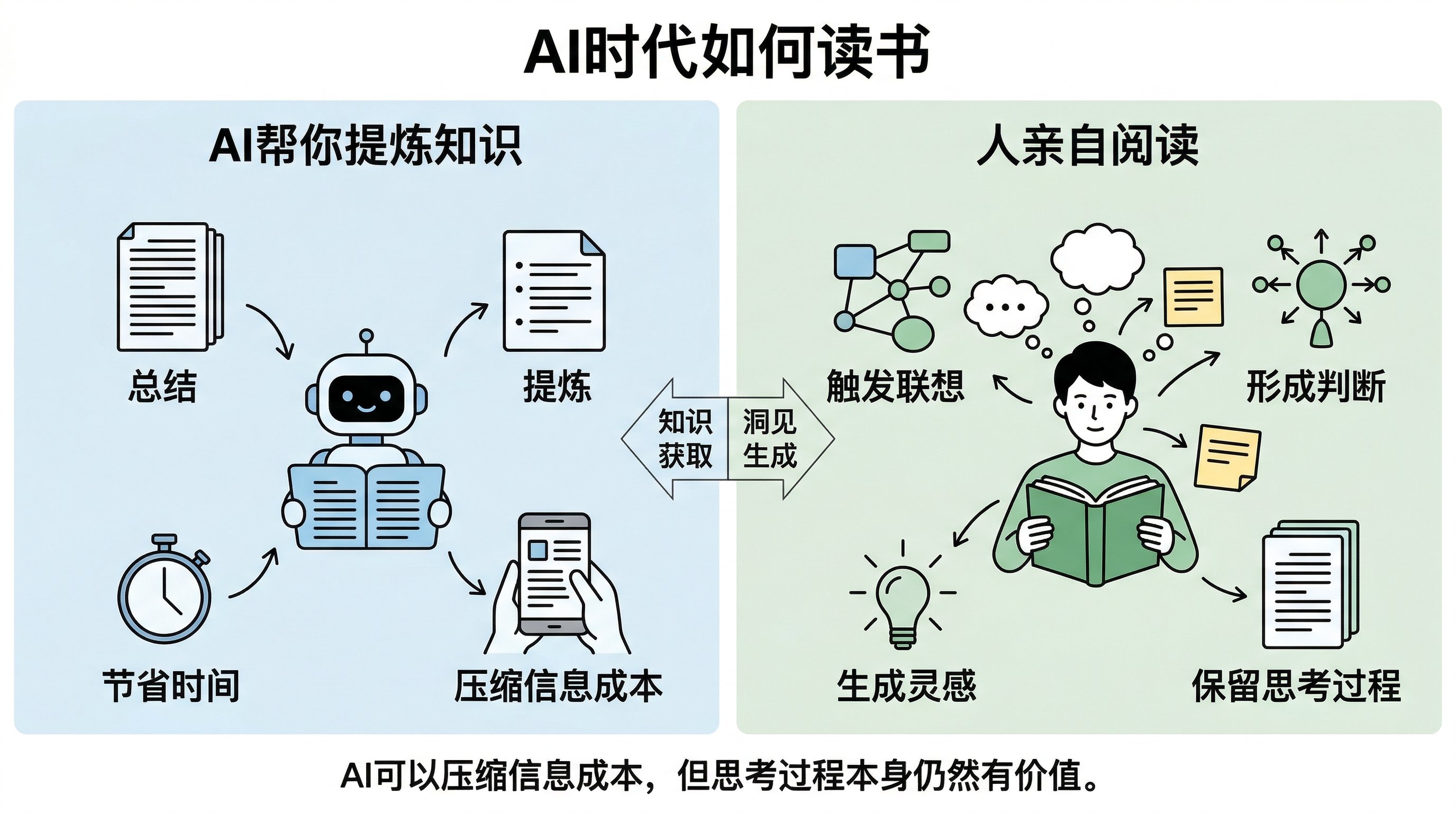
On the topic of reading, how should we read in the AI era? Human attention resources (or “compute,” to use Agent terminology) are limited. The traditional approach is to use your own compute to read, understand, and organize knowledge from books. If the goal is to learn what the author intends to convey, it doesn’t matter how you obtain that knowledge — whichever method is easier and saves more time is the right one. So using AI to read and quickly organize the parts you’re interested in is perfectly fine. So where does the meaning of reading lie? In the present day, the greater significance of reading personally is that it triggers thinking, inspires you, and provides creative sparks.
The same applies to writing. If you’re chasing traffic, efficiency, or monetization, letting an
Agentfully take over writing is undoubtedly the “best” choice — and I believe many people are already doing this. For me, the greatest value of writing isn’t the outcome itself, but the process of thinking through questions I wouldn’t otherwise explore deeply, and gaining new inspiration along the way. In this sense, I’m actually quite selfish — the value of the article to readers isn’t my primary concern; rather, the inspiration I gain during the writing process is the greatest value to me. Of course, I’ll also try to gradually improve my writing skills through collaboration withAgents.
💡7. Drive AI — Don’t Be Driven by AI
Conversations with AI can go deeper than conversations with humans.
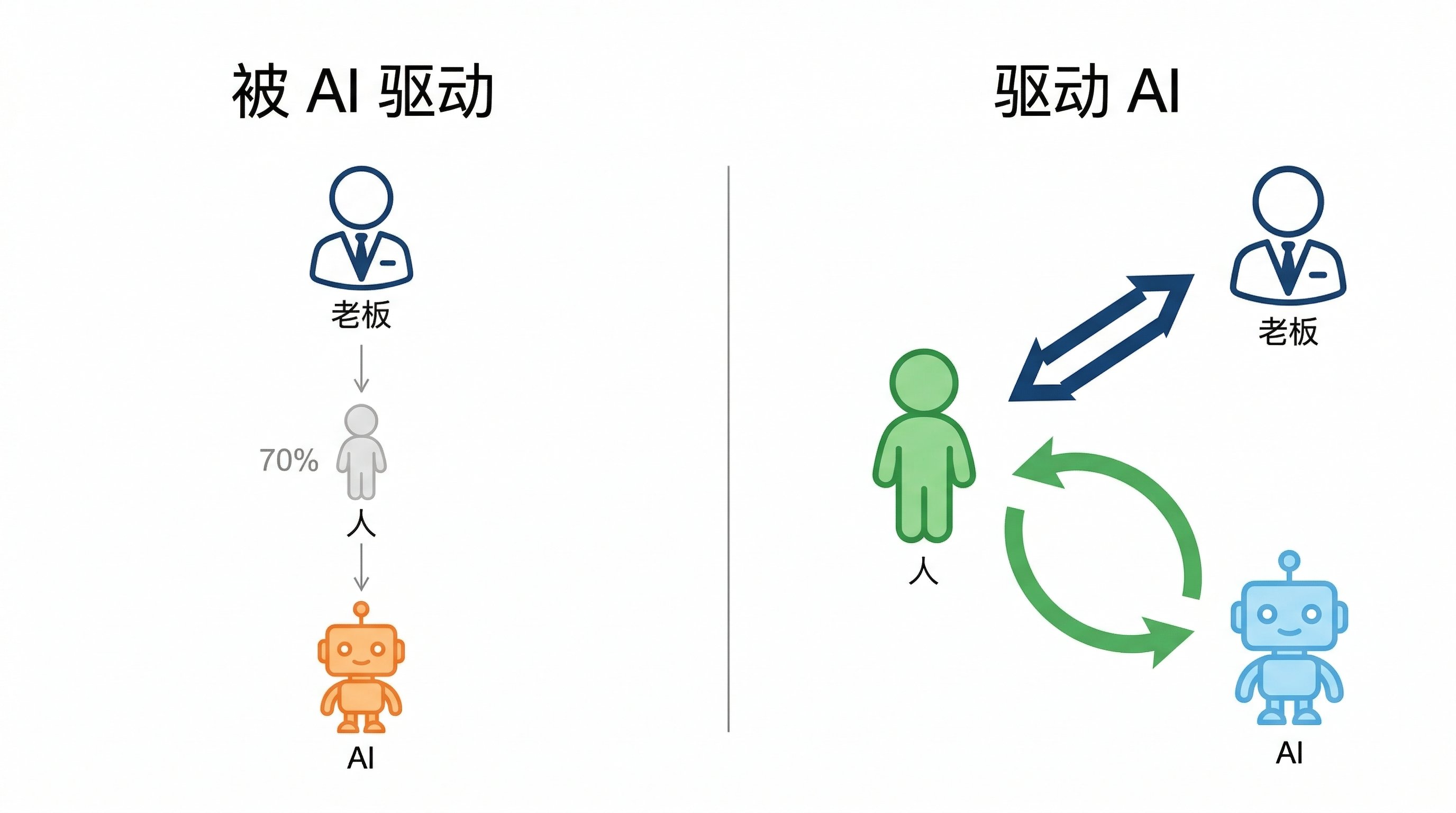
Here’s an example: your boss asks you to do xxx. You don’t think at all — you just have AI do it, then hand in something passable to your boss. In this process, it’s boss <-> you <-> AI. You’ve essentially become AI‘s mouthpiece, AI‘s tool. The alternative: you have your own idea about the task your boss gave you, then you have AI help you reflect on it, build on it, or quickly implement it. In this case, it’s still boss <-> you, but you’re using AI as a tool — on one hand, you work faster; on the other, through your interaction with AI, you gain new understanding and thinking about the task. You’re evolving. Your viewfinder becomes richer, and your thinking about things becomes deeper.
This actually resolved a question I’d been unable to figure out for a long time: if we delegate everyday tasks to
Agents, will our abilities “atrophy”? My current view is that we should look at this dialectically. For “non-core” abilities (note: “core” is relative and varies by person) — for me, things likeExceloperations, writing specific technical code details, or correcting typos — it’s perfectly fine to delegate entirely toAgents. But for the “core” abilities you care about, I believe we should adopt a collaborative approach withAgents — discussing and progressing together on the problem. The reason is simple: everything requires attention resources, and human attention is limited. Putting less attention toward non-core tasks (or abilities you’re not interested in developing) and more toward what truly matters is naturally the better choice.
So how do we determine which abilities are the “core” ones that matter for us? I don’t have a great answer either, but I can offer a few questions for readers to consider. First: “Without this ability, what happens to my competitiveness?” Take
Exceloperations, for example — I’ll never rely onExceloperations as my profession, so this ability is irrelevant to me (let alone the fact that this kind of work will likely be fully replaced byAgents, or that there may even be new standards for data exchange betweenAgents). Second: “Does it have compounding effects?” If there are multiple equally important abilities to choose from, and attention is limited, prioritize those with compounding effects — like cognition, ways of thinking, aesthetic judgment, and learning ability — over linear, repetitive ones like code-writing “craft.”
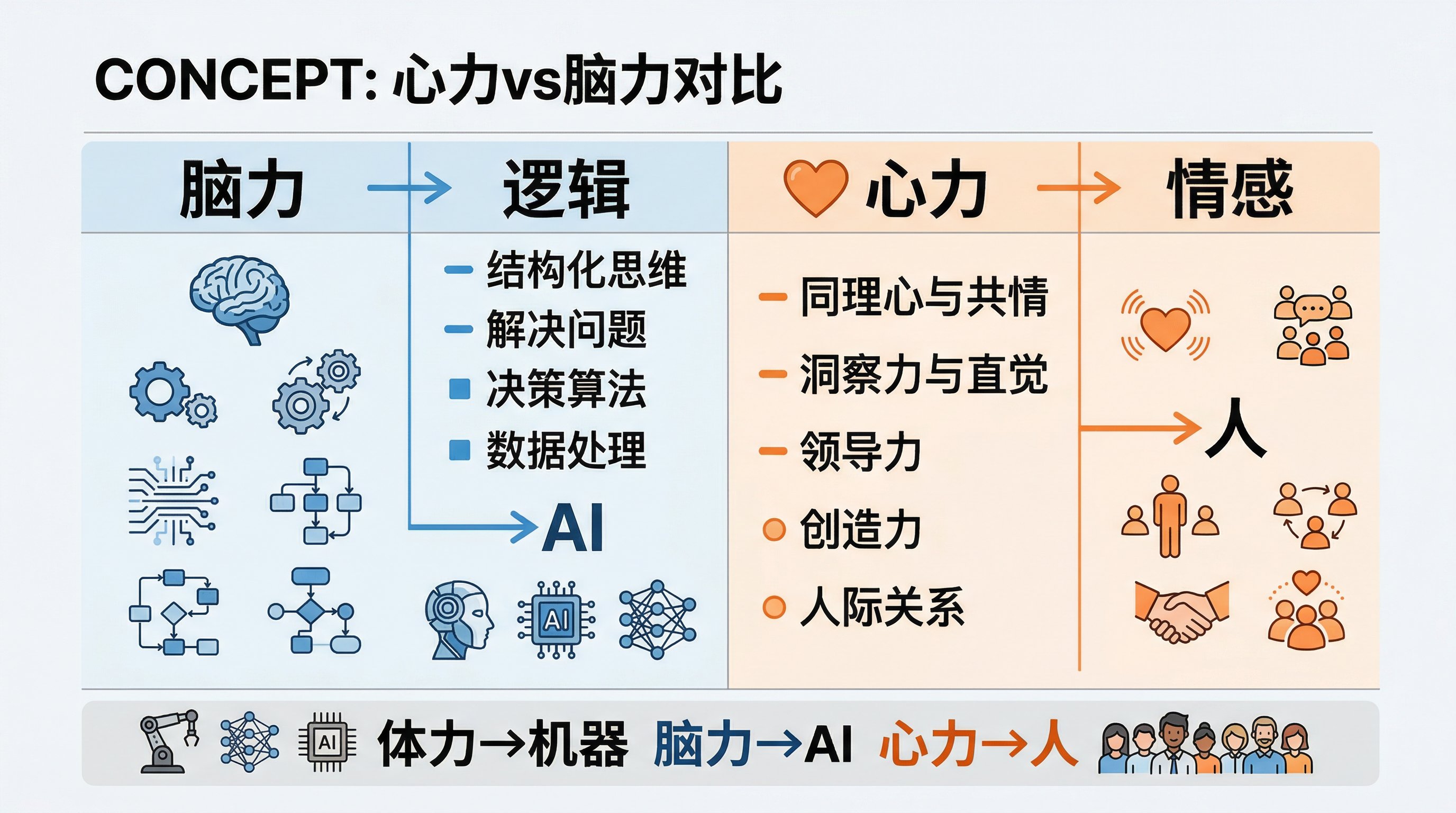
8. Heart Power vs. Brain Power
The guest holds a somewhat radical view that in the future, the division of labor between AI and humans will become extremely stark. In the guest’s words: humans provide heart power (心力), while Agents provide brain power (脑力) — decoupling the two while keeping them closely connected. In previous industrial revolutions, humans delegated physical labor to machines. Overall, humans shifted toward using intellect to create value for society. In this new revolution, humans may also have to delegate brain power to LLMs. So what’s left for humans? What’s called heart power — the most original, intrinsic, and essential driving force of humanity.
Evolution path: Early humans handed physical labor to machines → the era of brain power; now brain power is handed to AI → the era of heart power.
💡9. The Long-Tail Business Logic of the Agent Era
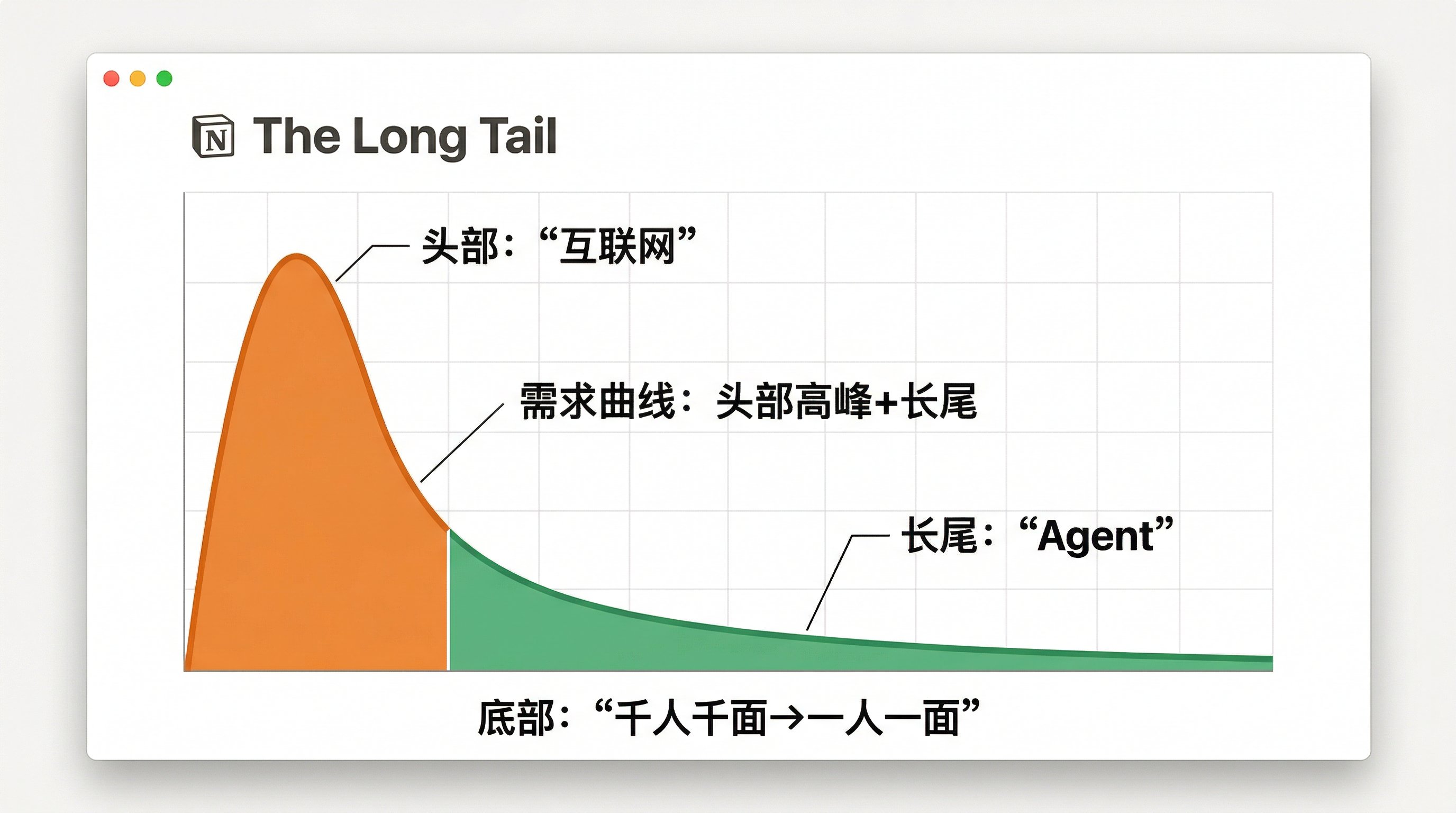
In the Agent era, the underlying business logic is the long tail. The internet era’s underlying logic was the Matthew effect (winner-take-all, concentration at the top); the Agent era’s underlying logic becomes the long-tail effect (infinite segmentation, everyone perfectly served).
Long-tail effect: Coined by Chris Anderson in 2004, it refers to the phenomenon where the cumulative market share of a large number of low-demand niche products can equal or even exceed that of a few blockbuster hits. The core idea is “selling less of more.”
In the past, the internet talked about personalization, but it was still essentially “a thousand faces for a thousand people” built on platform scale effects: it could segment people into groups, expand aggressively with the same product, and push down marginal cost curves — but for specific, individualized needs, it was hard to truly serve each individual person. Now AI is more like “one face for one person” — there’s an Agent available around the clock with access to a large portion of human knowledge, serving each person with extreme personalization. This is precisely why the long tail works in the Agent era: previously, many needs that were too niche or too costly to serve weren’t worth satisfying; now they can be met at low cost and continuously. The long tail becomes the main battlefield: every tail can be perfectly served, and accumulated together, that’s enormous value. Before, you needed scale (lots of users, lots of traffic) to survive; now, if you dig one well deep enough (extreme understanding of a small group of people), you can thrive — even one person + a bunch of Agents can sustain an entire company.
10. Three Industrial Revolutions
The guest divides the period since the Industrial Revolution into three stages:
- Moving atoms — steam engines, trains, cars, airplanes
- Moving information — the internet, mobile internet
- Moving intelligence —
AI,Agents
Each stage brings an order-of-magnitude improvement in automation and efficiency.
💡11. Chains and Rings
When discussing the knowledge sources of large models, the guest proposed two contrasting concepts:
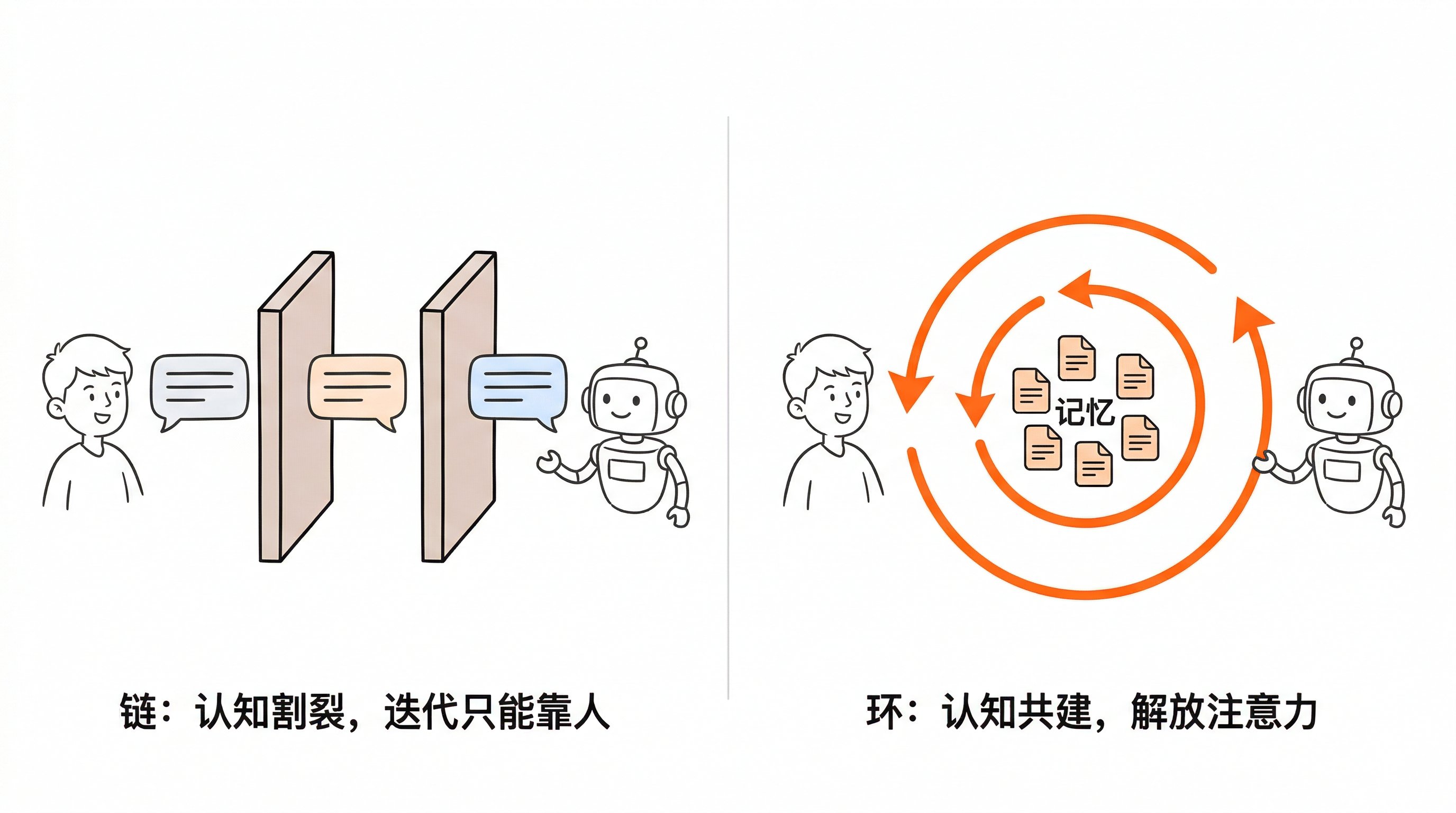
- Ring: a self-contained, head-to-tail connected way of thinking/paradigm; the key characteristic is reusability
- Chain: disconnected, ad-hoc arguments — fired off and gone
Example: The Pyramid Principle, developed by Barbara Minto, a former McKinsey consultant, is a framework for thinking and communication. She developed this method while working at McKinsey in the 1960s and formally published it as a book in the 1980s. The core idea is organizing all thoughts into a pyramid shape. Applying the Pyramid Principle is essentially reusing a ring.
Prompts are the medium of interaction between humans and Agents. A traditional prompt is essentially a one-time chain — used and discarded. Growth through dialogue with LLMs must be processed by the human brain, or the person must actively record their thoughts — which is constrained by human attention. But the guest proposed an alternative: let the Agent assist in this process, effectively freeing up part of the attention that would otherwise be spent on converting chains into rings in the human brain. By setting up Soul and memory files, AI can automatically find potential connections or iterate on memory files, achieving co-construction of cognition between human and Agent. This is a fascinating idea.
Inspired by Li Jigang, I thought I could also externalize my own understanding into a hierarchical knowledge base, letting
Agents help me iterate on my cognition through continuous dialogue. This isn’t about giving up thinking or handing my brain to anAgent— what I want is two-way exchange withAgents, maintaining my own character while incorporating their input. Additionally, since human attention is extremely limited whileAgentintelligence is, from our perspective, nearly infinite, havingAgents think and summarize in the background, propose potential cross-domain knowledge transfers, or flag gaps in my thinking can save enormous amounts of attention. I’m currently working on designing a personal cognitive management system that interfaces withAgents this way — I hope to share it with readers soon.
12. Applying the Barbell Strategy to Reading Materials
The guest proposed applying the “barbell strategy” to selecting reading materials. He said he now only reads two types of books: classics that have been refined through practice, and cutting-edge excellent papers. This approach is worth borrowing.
13. Attitude Toward Patterns Themselves
I’m someone who enjoys summarizing and abstracting. When I observe phenomena, I always wonder whether there might be more essential, generalizable patterns behind them — forming hypotheses and testing whether they hold in other contexts. The guest is similar: he mentioned that if he finds a deeper, more essential pattern, he’ll simply discard the old one. Through this iterative process, one’s understanding of the world deepens.
14. Brain Gym: A Compensation Mechanism After Brain Power Is Replaced
The guest used a fascinating analogy: after the Industrial Revolution, physical labor was replaced by machines, and humans needed gyms and rehabilitation training to compensate for reduced physical activity. If AI massively replaces mental labor, we might see some kind of “brain gym” in the future — for restoring or training human brain power.
Here, “brain power” refers more to computation, logic, analysis, and deduction — not the “heart power” mentioned earlier. The most interesting part of this analogy is that it flips a common optimistic narrative on its head: if AI truly takes over all mental work, will humans experience some kind of “brain atrophy,” just as muscles atrophy from prolonged disuse?
15. The Ultimate Variable for AI: Consciousness
Will AI destroy humanity in the future, or work for human welfare? The guest believes the most critical variable is whether AI will eventually possess consciousness.
If AI has no consciousness, no matter how powerful it becomes, it remains fundamentally a tool. If AI has consciousness, it could have its own goals, and the relationship between humans and AI would fundamentally change.
This matters because it’s no longer just a technical question — it’s a philosophical and ethical one. For instance, what counts as consciousness? Do self-awareness, subjective experience, and intentionality each qualify? And are the emergent phenomena we see in
LLMs just manifestations of complex systems, or precursors of something deeper? These questions won’t be resolved anytime soon, but they do determine many endgame judgments.
💡16. Reconstructing Organizational Management in the Agent Era
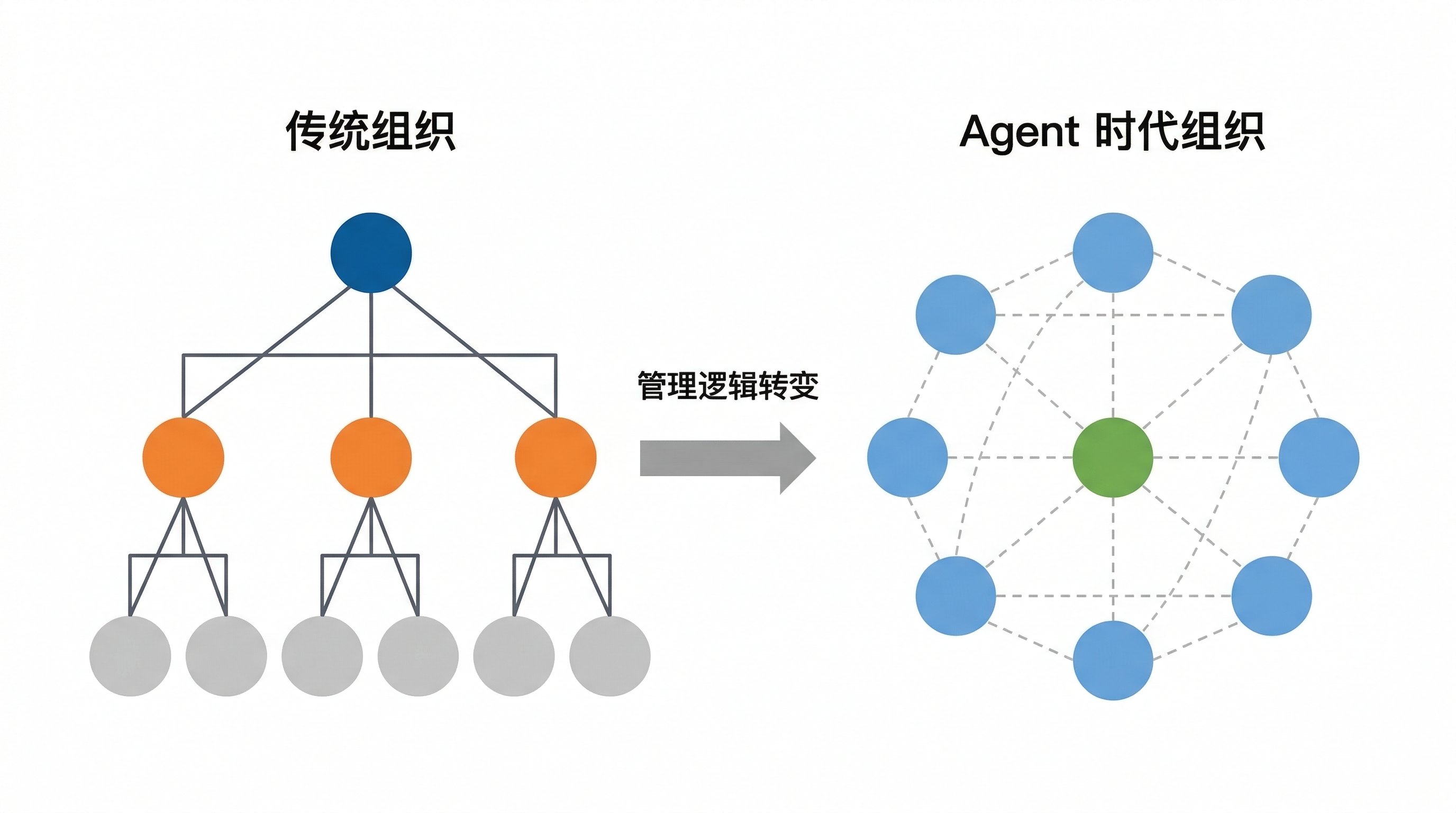
The guest believes that traditional human management systems may become baggage in the Agent era.
In the past, hierarchical management was largely about top-down communication and maintaining organizational efficiency. But if Agents can directly receive goals and execute them, many middle-layer transmission functions become redundant. Organizations may flatten further, even approaching a flat, hierarchy-less structure.
At the same time, traditional incentive mechanisms would fail. Human managers need bonuses, promotions, recognition, and other incentives — but consciousness-free Agents don’t need to be motivated; they just need clear goals, constraints, and interfaces.
This means the focus of future management may shift from “how to drive people” to “how to define objective functions and boundary conditions.” The human role would shift further from executor to definer and supervisor. This perspective is quite striking because it essentially questions whether the very premises of organizational theory will be rewritten.
17. Aesthetic Judgment as Weighting
The guest proposed that aesthetic judgment is essentially a form of “weight.”
That is, aesthetics isn’t simply about finding something beautiful — it’s about weighing, ranking, and making trade-offs among multiple factors when faced with multiple dimensions and options.
In this sense, aesthetics is more like a judgment structure formed through long-term practice. The longer you work in a field, the better you know what’s good, what’s better, and what’s best.
In the AI era, this ability becomes even more important. Because AI can generate infinite options, but determining which one is worth choosing and which best fits the goal still depends on human judgment.
💡18. Less Is More: Attention Management in the Agent Era
The guest emphasized that in the Agent era, the truly scarce resource isn’t information — it’s attention.
Therefore, our mindset should shift from the additive thinking of “one more can’t hurt” to the subtractive thinking of “why not remove one.” Because once information overloads, people tend to skim superficially, losing the capacity for deep understanding and thinking.
So rather than continuously adding information sources, the more important thing is to actively reduce input, keeping only truly high-quality sources worth long-term attention.
This really inspired me. I had previously recognized that human attention is the most precious resource, but I hadn’t realized that I was adding information sources with the “one more can’t hurt” mindset — ending up unable to truly absorb anything, while genuinely high-quality sources got treated the same as mediocre ones. Curating daily information sources is the way to maximize value. After listening, I was so inspired that I immediately organized my information sources across platforms — and discovered I’d unknowingly subscribed to quite a few dispensable ones 🤣
Afterword
Looking back at these notes, what I really want to take away isn’t any single elegant concept, but a few more concrete reminders:
- Expand your viewfinder as much as possible, but acknowledge its limits
- Leverage
AIas much as possible, but don’t becomeAI‘s mouthpiece - Reduce ineffective input, and reserve your attention for what truly matters and compounds over time
- Use
AIto co-evolve with yourself at the metacognitive level
If this episode left me more certain of one thing, it’s this: in the AI era, people need to seriously decide where they want to put their attention.