This post is a collection of the author’s random thoughts, which may inevitably have shortcomings in terms of professionalism. If there are any errors, feel free to discuss and correct them.
Many people want to make money. Let’s set aside the question of why we make money for now, and only examine the act of making money itself, exploring the differences between “making money” and “making money.”
Level 1: 1 unit of labor → 1 unit of return
When it comes to making money, the work most people do essentially falls into this category: 1 unit of labor → 1 unit of return. That is, the time and energy you put in—say, working a day at the office or delivering a food order—can predictably yield only a single return.
Although income disparities between jobs are enormous, none of them have much “room for imagination.” At their core, they are still a direct trade of labor for return.
Level 2: 1 unit of labor → x units of return
Some work has a different property: after putting in 1 unit of labor, you receive multiple returns. And this kind of return is often uncertain, which means its room for imagination is huge. This doesn’t include cases like getting bonuses or allowances on top of your salary—those still fall within the predictable category.
For example, on a large scale, a company can file a patent and keep profiting from licensing fees; on a small scale, an independent developer can build a piece of software and monetize it. In both cases, the expected profit is unknown, and after the initial labor, the worker doesn’t need to labor again (or only needs to pay a very low cost) to keep receiving returns multiple times.
I had a simple experience of my own: I collected some resources online (which still had a certain paywall), uploaded them to various cloud drives, and listed them for sale on Xianyu. Aside from the time and effort I spent collecting the resources, my only ongoing cost was the subscription for the Xianyu shipping bot: 120 yuan per year. Within two months, from just one product, I had already recouped my costs and made several times over. The amount wasn’t much, but it let me experience the difference between 1 unit of labor → x units of return and 1 unit of labor → 1 unit of return.
In fact, the work done by the developers of the shipping bot is similar to mine. The development cost can yield x units of return, and afterward, only some server maintenance and update costs are needed. The labor they put in earlier will continue to earn them income years later.
Level 3: 1 unit of return → x units of return
Seeing this heading, you might be surprised: how can returns generate more returns? Of course they can.
This is the method that truly makes big money, and even influences the world’s financial landscape: money making money. Many of the world’s wealthy individuals and financial giants have accumulated enormous fortunes precisely this way. The core idea of money making money is to use various investment strategies to keep growing your existing capital, rather than relying solely on the simple exchange of labor → return.
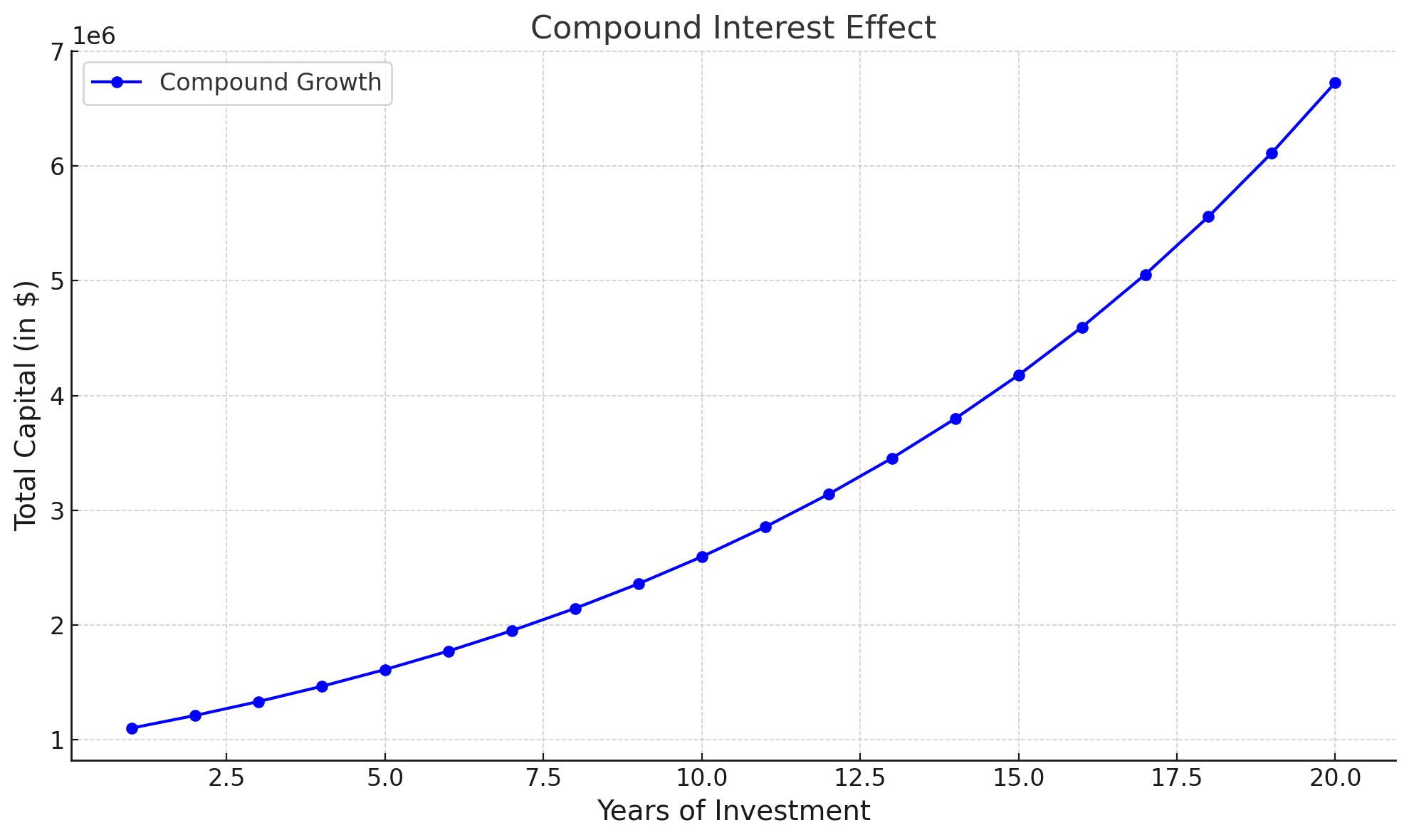
Compound interest is called the “eighth wonder of the world.” Its power lies in the fact that not only does the principal grow, but the interest also generates more interest.
For example, suppose you invest 1 million yuan at an annual interest rate of 10%. After one year, you’ll earn 100,000 yuan in interest. If you reinvest that 100,000 yuan, your total capital will grow to 1.21 million yuan in the second year, not just 1.1 million yuan. Over the long run, the compounding effect will make your wealth grow exponentially.
Of course, the threshold and risk of this approach are absolutely not something ordinary people can handle, and only a very few can actually make money.
Ordinary people can also invest well. The prerequisite is having sufficient financial reserves and experience. Learning to invest is a highly rewarding “meta-investment.”
Level x: Investing in yourself
In fact, there is a “sure-win” deal: investing in yourself and improving your own abilities. From a utilitarian perspective, doing so can elevate your level of making money.
Of course, investing in yourself here doesn’t mean simply learning technical skills, like getting a Mandarin Level 2 certificate or a Computer Level 2 certificate, but rather investing in skills that enhance your cognitive abilities. How you interact with others, how you understand the operating logic of the world, how you understand personal meaning, and so on. The returns on this investment are unknown, and the butterfly effect it produces will influence our entire lives.